- No products in the cart.


24 September 2026
The construction of public sector homes has collapsed over the past four decades, and recent Federal Budget changes risk making an already challenging situation worse, according to a submission being lodged today by Master Builders Australia to the Parliamentary Inquiry into Social Housing.
CEO Denita Wawn said today, while government programs like the Housing Australia Future Fund and other initiatives have set the stage to prioritise the delivery of social housing, you can’t accelerate demand and, at the same time, put a hand break on supply.
“With building and construction businesses and their investment set to be taxed more heavily, it will have negative consequences for the cost of building new social housing stock and other homes,” said Ms Wawn.
“Housing investors are central to private rental supply. The May 2026 Federal Budget’s restrictions to negative gearing, self-managed superfunds and Capital Gains Tax makes it less attractive and more expensive to be in the market, placing upward pressure on rents according to independent modelling. This makes it likely that a greater number of households are likely to find themselves in need of social housing.”
As a member of the National Affordable Housing Alliance of peak bodies, unions, the superannuation and community housing sector, Master Builders Australia says the delivery of social housing is a key part of the housing continuum.
“The barriers are well documented. Increased risk in the financial viability of projects, a collapse by 21.5 per cent in productivity over the last decade, 51.6 per cent increases to building costs since the pandemic and construction workforce shortages are all adding to delays and propelling costs upwards,” said Ms Wawn.
“We are running short of every type of home, a turbo charging of social housing requires a construction policy environment that expands industry capacity, lifts productivity and ensures every dollar of public and private investment delivers the greatest possible increase in housing supply.”
To support the delivery of social housing Master Builders recommends:
- Supporting investment in social housing by encouraging government to support the widening of low-cost financing options for the creation of new homes by social housing providers
- Addressing the needs of the private rental market by reversing the May 2026 Federal Budget measures impacting negative gearing, capital gains tax, the higher taxation of trusts and the ban on borrowing by Self-Managed Super Funds for housing be reversed. Doing so will allow more housing supply to reach the rental market and help dilute rental inflation, reducing the demands on social housing stock
- Addressing the costs of building new homes by pulling a range of policy levers targeted at:
- expanding the size and capability of the construction workforce,
- reducing the regulatory burden,
- strengthening industry supply chains, and
- using the government procurement process to enhance competitive settings.
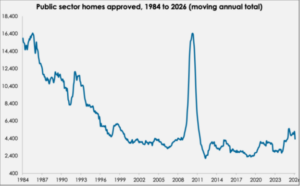
The chart below illustrates how the construction of new public housing has declined sharply over the past 40 years, although there has been a slight improvement over the past few years. The GFC period in the late 2000s decade saw a remarkable – and short lived – surge in the construction of new public housing. It does not capture the creation of all forms of social housing. New homes constructed for Community Housing providers are classified as private sector in the official data.
Media contact: Dylan Hafey, Adviser, Media & Government Relations
0497 330 064 | dylan.hafey@masterbuilders.com.au